
The Five Elemental Shrines of Shiva – A Complete Guide to the Pancha Bhoota Linga Temples
If you’ve ever felt the earth beneath your feet, heard the wind whisper through the trees, watched a flame dance, listened to a river’s murmur, or sensed the boundless space above you, you’ve experienced the five elements that ancient Indian philosophy calls Pancha Bhoota – Earth, Water, Fire, Air and Ether (Space).
In the Shaivite tradition these elements are each embodied by a linga (the iconic symbol of Lord Shiva) in a separate temple. Together they form the Pancha Bhoota Sthalam – a pilgrimage circuit that stretches across Tamil Nadu (and a dash of Andhra Pradesh) and offers a rare, tangible way to meditate on the very building blocks of the universe.
Below is everything you need to know: the mythic origins, the architectural highlights, practical travel tips, and a handy checklist for completing the pilgrimage.
- Spiritual synthesis – Each linga teaches that Shiva pervades every facet of existence. Meditating on the five shrines is a fast‑track to understanding the unity of matter and consciousness.
- Architectural marvels – Built between the 7th and 14th centuries, the temples showcase Dravidian brilliance: towering gopurams, intricate stone carvings, and vibrant frescoes.
- Cultural immersion – Festivals (like Mahashivaratri, Karthigai Deepam, and Panguni Uthiram) turn these sites into living stages of music, dance, and ritual.
- Travel adventure – The circuit spans roughly 600 km, crossing bustling cities, serene riverbanks, forested hills, and coastal plains – a perfect road‑trip for history‑buffs and nature lovers alike.
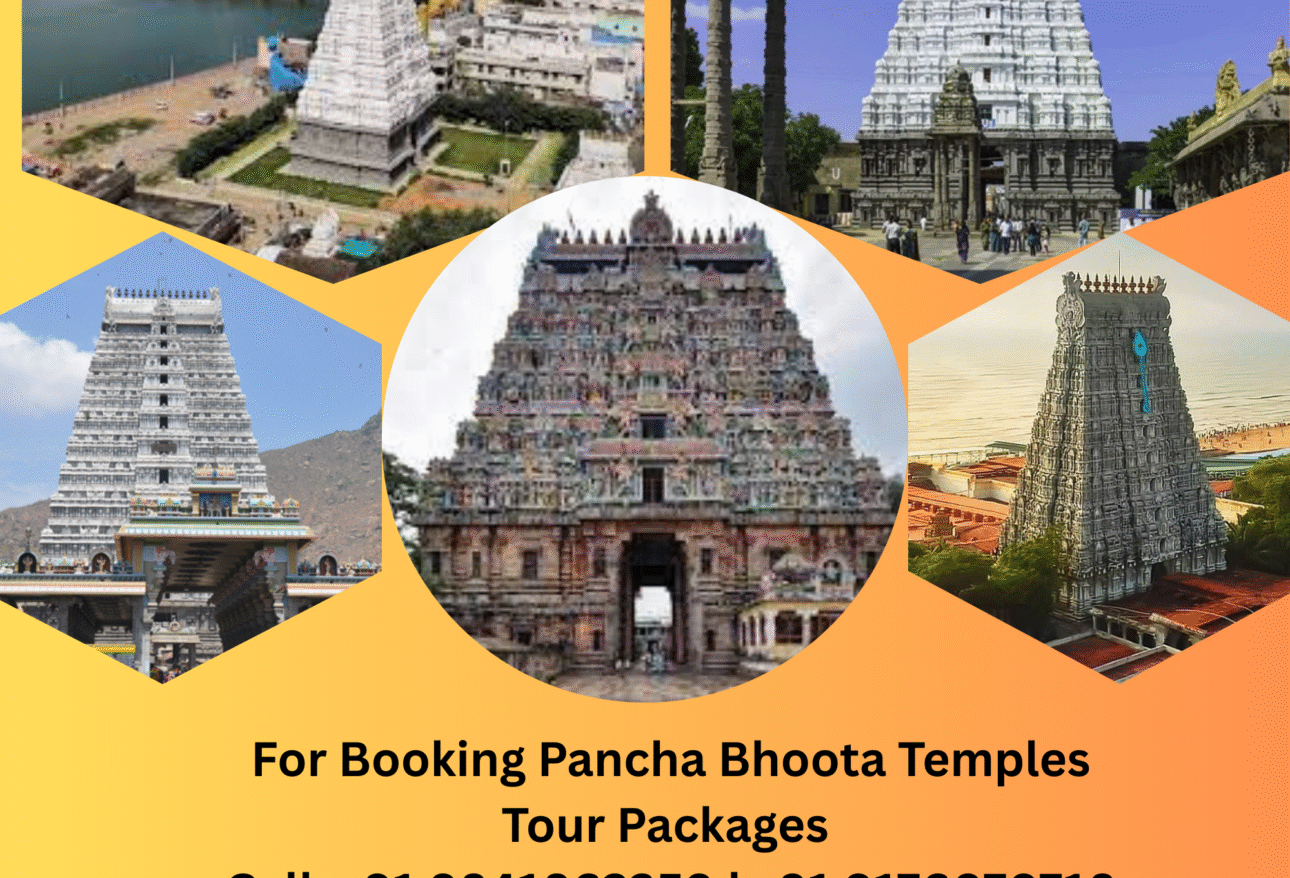
| S.No | Element | Temple ( Town ) | State | Distinct Iconic Feature |
|---|---|---|---|---|
| 1 | Earth (Prithvi) | Ekambareswarar – Kanchipuram | Tamil Nadu | 12‑meter‑high “Moolavara” (root) lingam amid a massive banyan tree |
| 2 | Water (Appu) | Jambukeswarar – Thiruvanaikaval | Tamil Nadu | Lingam forever dripping water from a concealed source |
| 3 | Fire (Agni) | Annamalaiyar – Thiruvannamalai | Tamil Nadu | Annamalai Hill (the living lingam) and the spectacular Karthigai Deepam flame |
| 4 | Air (Vayu) | Srikalahasti – Srikalahasti | Andhra Pradesh | Vayu lingam that sways with the breeze; famed Kannappa legend |
| 5 | Ether/Space (Akasha) | Nataraja – Chidambaram | Tamil Nadu | Golden “Chidambara Rahasyam” (the secret of space) in the sanctum |
Below each temple’s story is paired with a short “what to see” list and a few practical notes for travelers.
Mythic Roots
Legend says Parvati, seeking to marry Shiva, performed severe penance under a banyan tree. Moved by her devotion, Shiva manifested as an earth‑lingam (called Prithvi Linga) beneath the tree. The temple’s name “Ekambareswarar” translates to “Lord of the One Banyan”.
What to See
- Four‑storey gopuram – the tallest in Kanchipuram, painted in vivid reds and golds.
- The massive banyan – over 300 years old, its roots cradle the lingam.
- Maha Mandapam – a pillared hall adorned with sculptures of the 27 Nayanmars (Shaiva saints).
- Kamakshi Amman Temple (just a stone’s throw away) – perfect for a combined pilgrimage.
Visitor Tips
- Best time: Early morning (6–8 am) for cooler temps and fewer crowds.
- Dress code: Traditional attire; women may cover shoulders.
- Parking: Paid lot behind the western gate; a short 5‑minute walk to the main shrine.
Mythic Roots
The sage Vishwamitra meditated here, longing for a river to flow within the sanctum. Shiva obliged, making a perennial water stream flow over the lingam, hence the name “Jambu” (the water‑loving tree).
What to See
- The ever‑dripping lingam – situated in a shallow pool; watch the water cascade continuously.
- Gold‑plated hall (Palliyarai) – where the deity’s sacred ornaments are displayed annually.
- The “Azhwar” shrine – a side sanctum dedicated to the Vaishnavite saint, showcasing the temple’s inclusive spirit.
- The river Kaveri – just 2 km away; a perfect spot for sunset reflections.
Visitor Tips
- Season: Post‑monsoon (Oct‑Dec) when the water flow feels most vibrant.
- Photography: Allowed only in the outer courtyards; the inner sanctum is strictly no‑camera.
- Food: Try the local “Kuzhi Paniyaram” from street stalls near the temple entrance.
Mythic Roots
According to the Skanda Purana, Shiva once appeared as an immense column of fire on Annamalai Hill to test the devotion of Brahma and Vishnu. The hill itself is now worshipped as a living lingam.
What to See
- The massive gopuram (Nandhi Mandapam) – 66 meters tall, illuminated nightly.
- The “Girivalam” path – a 14‑km circumambulatory walk around the hill, especially vibrant on full‑moon nights.
- Karthigai Deepam (December) – a colossal flame lit atop the hill, visible for miles.
- The “Arunachaleswarar” shrine – the inner sanctum with a fire‑shaped lingam.
Visitor Tips
- Accommodation: Plenty of ashrams and budget guesthouses; many offer prasad (holy food) to pilgrims.
- Footwear: Remove shoes before entering the hill path; sturdy walking shoes recommended.
- Timing: The temple opens at 5 am; the early aarti (prayer) is a moving experience.
Mythic Roots
The legend of Kannappa, a tribal hunter who offered his own eyes to Shiva out of love, is the heart of this shrine. The air lingam is said to be suspended in the sanctum, moving subtly with the wind—symbolising the invisible yet ever‑present Vayu.
What to See
- The 18‑storey gopuram – a kaleidoscope of stonework, painted in turquoise and gold.
- The “Nandi” statue – a massive bronze bull that seems to “breathe”.
- The “Kshetra Sthalam” (holy pond) – where pilgrims take ritual baths.
- Kannappa’s shrine – a modest yet deeply moving sanctum honoring the devotee’s sacrifice.
Visitor Tips
- Travel: The nearest railway station is Srikalahasti (SRKT); frequent buses connect to Tirupati (30 km away).
- Best season: Winter (Nov‑Feb) when the breezes are pleasant for the hill‑top walk.
- Local delicacy: “Bobbatlu” (sweet flatbread) sold at nearby stalls.
Mythic Roots
Here Shiva is depicted as Nataraja, the cosmic dancer whose rhythmic movements create the universe. The sanctum contains the “Chidambara Rahasyam” – an empty space behind a curtain that represents Akasha, the all‑pervading ether.
What to See
- The golden “Marmam” (the secret) – a brass plate with a gold leaf; lifting it reveals the hidden space.
- The “Thillai Nataraja” bronze idol – an artistic marvel of 1.35 m height, frozen mid‑dance.
- The 100‑pillared hall – covered with exquisite frescoes illustrating Shiva’s legends.
- The annual “Natyanjali” dance festival – a gathering of classical dancers from across India.
Visitor Tips
- Timing: Arrive before 6 am for the “Thiruvempavai” (morning hymn) chanting.
- Dress: Traditional saree or dhoti recommended; the temple’s strict dress code is enforced.
- Nearby: The Pichavaram Mangrove Forest (45 km) makes a perfect day‑trip.
Popular Pancha Bhoota Lingam Tour Packages
| Tour Name | Duration | Price View |
|---|---|---|
| Pancha Bhoota Sthalam Package Chennai | 3 Days | View Price |
| Pancha Bhoota Temples Tour Package Chennai | 4 Days | View Price |
| Pancha Bhoota Lingam Tour Package Chennai | 5 Days | View Price |
| Pancha Bhoota Temples Tour Package Trichy | 4 Days | View Price |
| Pancha Bhoota Temple Tour Package Bangalore | 4 Days | View Price |
| Pancha Bhoota Sthalam Tour Package Tirupati | 4 Days | View Price |
| Pancha Bhoota Temple Tour Rameshwaram | 4 Days | View Price |
Pilgrims who undertake the journey across these five temples believe they are not only worshiping Shiva but also harmonizing the five elements within their own bodies. According to Ayurveda and Yoga, human health and spiritual growth depend on the balance of these elements. Thus, visiting these temples is more than a religious act—it becomes a soul-aligning pilgrimage.
The Pancha Bhoota Linga temples offer more than divine encounters—they teach us that everything in the universe, including ourselves, is made of the same five elements. By honoring these sacred sites, we reconnect with nature, recognize the divinity within all matter, and move closer to the realization of oneness.
Whether you’re a devout pilgrim or a spiritual seeker, a visit to the Pancha Bhoota temples is a journey through the essence of existence itself—one element at a time.