

Pancha Bhoota Temples List: Complete Guide to the 5 Element Shiva Temples (Location, Distance, Map & Travel Tips)
The Pancha Bhoota Temples (also called Pancha Bhoota Sthalams) are five sacred Shiva temples in South India. Each is dedicated to one of the five great elements, or pancha bhoota: earth, water, fire, air, and space. Four are in Tamil Nadu and one is in Andhra Pradesh.
Whether you are planning a pilgrimage, a heritage trip, or a long road journey from Chennai, this guide covers the complete list, locations, distances, legends, timings, and travel tips.
Pancha Bhoota Temples at a Glance
| Element | Sanskrit / Tamil Name | Temple | Location | State |
|---|---|---|---|---|
| Earth | Prithvi / Nilam | Ekambareswarar Temple | Kanchipuram | Tamil Nadu |
| Water | Jala (Appu) / Neer | Jambukeswarar Temple | Thiruvanaikaval, Trichy | Tamil Nadu |
| Fire | Agni / Thee | Annamalaiyar Temple | Tiruvannamalai | Tamil Nadu |
| Air | Vayu / Kaatru | Srikalahasti Temple | Srikalahasti | Andhra Pradesh |
| Space | Akasha / Aagayam | Thillai Nataraja Temple | Chidambaram | Tamil Nadu |
Traditional order: Kanchipuram (earth) → Thiruvanaikaval (water) → Tiruvannamalai (fire) → Srikalahasti (air) → Chidambaram (space).
What Is the Meaning of Pancha Bhoota?
In Indian philosophy, the physical world and the human body are made of five elements: earth (prithvi), water (jala), fire (agni), air (vayu), and space (akasha). The Pancha Bhoota Sthalams are the places where Shiva is worshipped as the formless power behind each element. The shrines are celebrated in the Tamil devotional hymns of the Nayanmar saints, and the pilgrimage is believed to bring devotees closer to balance within themselves and with nature.
1. Ekambareswarar Temple, Kanchipuram (Earth)
Location: Kanchipuram, about 75 km from Chennai
Deity: Ekambareswarar (Prithvi Lingam) with Goddess Elavarkuzhali
Element: Earth
Kanchipuram is known as the “city of a thousand temples.” According to legend, Goddess Parvati made a lingam out of sand beneath a mango tree and worshipped Shiva. When a flood threatened it, she embraced the lingam to protect it. The sand lingam is therefore anointed gently, with ritual rather than water abhishekam.
Highlights:
- A towering southern gopuram, among the tallest in Tamil Nadu
- A hall of 1,000 pillars
- An ancient mango tree in the complex, said to be thousands of years old
- Pallava, Chola, and Vijayanagara period architecture
Nearby: Kamakshi Amman Temple, Kailasanathar Temple, Varadharaja Perumal Temple, Kanchipuram silk sarees
2. Jambukeswarar Temple, Thiruvanaikaval (Water)
Location: Thiruvanaikaval, Tiruchirappalli (Trichy), about 330 km from Chennai
Deity: Jambukeswarar (Appu Lingam) with Goddess Akilandeswari
Element: Water
The sanctum has a natural underground spring that keeps the area around the lingam wet throughout the year. The name comes from a jambu (rose-apple) tree and a famous legend of a white elephant and a spider that both worshipped Shiva here. In a well-known midday ritual, the priest dresses as a woman to offer worship to Shiva, symbolizing the Goddess’s devotion.
Highlights:
- Spring water around the lingam
- Five enclosures (prakarams) and multiple gopurams
- Elegant Chola-era sculpture
- Close to the Srirangam Ranganathaswamy Temple
Nearby: Srirangam, Rockfort Ucchi Pillayar Temple, Samayapuram Mariamman Temple
3. Annamalaiyar Temple, Tiruvannamalai (Fire)
Location: Tiruvannamalai, about 190 km from Chennai
Deity: Annamalaiyar (Agni Lingam) with Goddess Unnamulai Amman
Element: Fire
Built at the base of the sacred Arunachala hill, this is one of the largest temple complexes in India. The legend says Shiva appeared as an endless column of fire when Brahma and Vishnu argued over who was supreme. Every year during Karthigai Deepam (November–December), a huge fire beacon is lit on the hilltop, attracting devotees in very large numbers.
Highlights:
- Four towering gopurams, with the eastern one among the tallest in India
- Girivalam, a roughly 14 km walk around the hill, especially on full-moon nights
- Ashrams linked to Sri Ramana Maharshi and Seshadri Swamigal
Nearby: Sri Ramanasramam, Virupaksha Cave, Skandashram, Jawadhu Hills
4. Srikalahasti Temple, Andhra Pradesh (Air)
Location: Srikalahasti, Tirupati district, about 115 km from Chennai and about 36 km from Tirupati
Deity: Kalahastheeswara (Vayu Lingam) with Goddess Gnana Prasunambika
Element: Air
On the banks of the Swarnamukhi river, Srikalahasti is named after a spider (Sri), a snake (Kala), and an elephant (Hasti), all devotees of Shiva. Devotees believe the lamps near the sanctum flicker even without any draft, which is taken to symbolize the Vayu lingam. The temple is also linked to the hunter-saint Kannappa Nayanar, famed for his devotion.
Highlights:
- A temple partly built into a rock hillside
- Popular for Rahu-Ketu dosha pujas
- Combines easily with a Tirupati trip
Nearby: Tirumala Venkateswara Temple, Tiruchanur, Kanipakam Vinayaka Temple
5. Thillai Nataraja Temple, Chidambaram (Space)
Location: Chidambaram, Cuddalore district, about 245 km from Chennai
Deity: Nataraja (Akasha) with Goddess Sivakami
Element: Space (ether)
Chidambaram is unique among the five. The Chidambara Rahasyam, the “secret of Chidambaram,” is an empty space behind a curtain, representing the formless, all-pervading divine. This is also the best-known temple for Shiva as Nataraja, the cosmic dancer, shown in the Ananda Tandava pose.
Highlights:
- Golden-roofed Chit Sabha sanctum
- Carvings of dance postures (karanas) from the Natya Shastra on the gopurams
- Tradition of hereditary priests (Dikshitars)
- A shrine of Govindaraja Perumal (Vishnu) within the same complex
Nearby: Pichavaram Mangrove Forest, Gangaikonda Cholapuram, Annamalai University area, Vaitheeswaran Koil
Distance from Chennai to Each Pancha Bhoota Temple
| Temple | Approx. Distance | Approx. Drive Time |
|---|---|---|
| Kanchipuram | 75 km | 2 hrs |
| Srikalahasti | 115 km | 2.5–3 hrs |
| Tiruvannamalai | 190 km | 4–4.5 hrs |
| Chidambaram | 245 km | 5–5.5 hrs |
| Thiruvanaikaval (Trichy) | 330 km | 6–6.5 hrs |
Distance Between Pancha Bhoota Temples (Suggested Route)
| From | To | Distance | Drive Time |
|---|---|---|---|
| Srikalahasti | Kanchipuram | ~125 km | 2.5–3 hrs |
| Kanchipuram | Tiruvannamalai | ~100 km | 2–2.5 hrs |
| Tiruvannamalai | Chidambaram | ~150 km | 3–3.5 hrs |
| Chidambaram | Thiruvanaikaval | ~175 km | 3.5–4 hrs |
| Total | ~550 km | 12–14 hrs |
Distances are approximate. Check live routes on Google Maps before travelling.
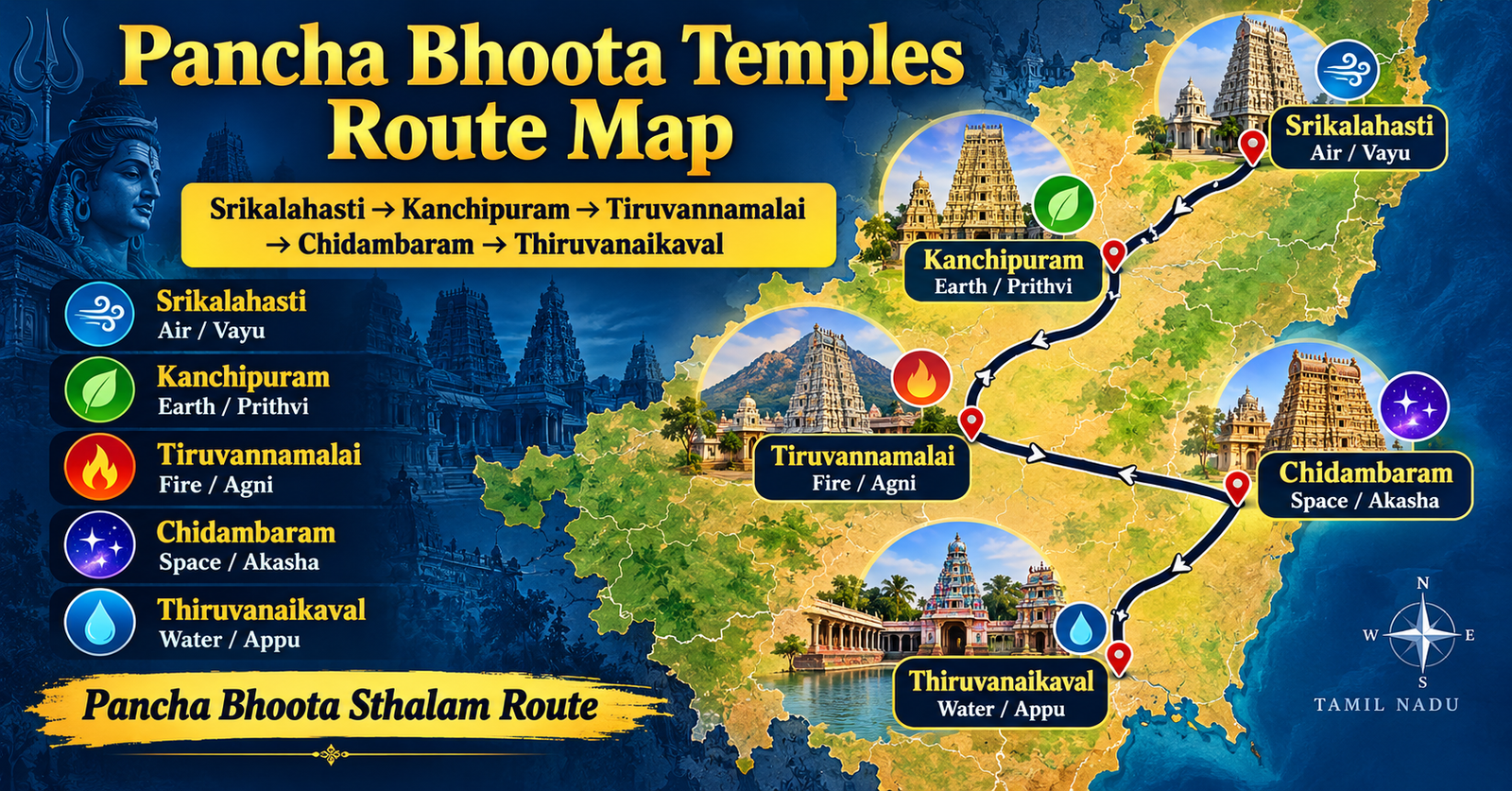
Chennai → Srikalahasti → Kanchipuram → Tiruvannamalai → Chidambaram → Thiruvanaikaval → Chennai
📍 Chennai
⬇️
🌬️ Srikalahasti – Air / Vayu
⬇️
🌍 Kanchipuram – Earth / Prithvi
⬇️
🔥 Tiruvannamalai – Fire / Agni
⬇️
✨ Chidambaram – Space / Akasha
⬇️
💧 Thiruvanaikaval – Water / Appu
⬇️
🏁 Chennai – Return Journey
Day 1: Chennai → Srikalahasti → Kanchipuram
- Early start for Srikalahasti darshan
- Lunch, then drive to Kanchipuram for evening darshan at Ekambareswarar
- Overnight in Kanchipuram
Day 2: Kanchipuram → Tiruvannamalai → Chidambaram
- Morning darshan at Annamalaiyar Temple
- Drive to Chidambaram
- Overnight in Chidambaram
Day 3: Chidambaram → Thiruvanaikaval → Return
- Morning darshan at Nataraja Temple
- Drive to Trichy for Jambukeswarar Temple
- Return to Chennai by train, bus, or an overnight drive
Want the Girivalam? Add a fourth day, or spend a night at Tiruvannamalai.
Pancha Bhoota Sthalam Temples Tour Package: Top Deals
Chennai to Pancha Bhoota Stahlam Tour package:
- 2 Nights 3 Days Package – Learn More
- 3 Nights / 4 Days Package – Learn More
- 4 Nights / 5 Days Package – Learn More
Trichy to Pancha Bhoota Sthalam Tour Package:
Rameshwaram to Pancha Bhoota Temples Tour Package :
Bangalore to 5 Elements Tour package:
Tirupati to Pancha Bhoota Lingam Tour Package:
Hyderabad to Pancha Bhoota Sthalam Tour Package:
Best Time to Visit
- October to February: Cooler weather, ideal for the whole circuit
- November–December: Karthigai Deepam at Tiruvannamalai, magnificent but extremely crowded
- February–March: Maha Shivaratri, with special night worship at all five temples
- April–June: Very hot, so plan early morning visits
How to Travel
- By car or cab: The most practical option for all five temples in 3 days
- By train: Trichy, Kanchipuram, Tiruvannamalai, Chidambaram, and Srikalahasti are all on rail routes, but connections between temples may require road transfers
- By bus: State transport buses link all towns, which suits budget travel
- By air: Nearest airports are Chennai, Tirupati (for Srikalahasti), and Trichy
Temple Timings (General)
Most temples open in the early morning, close for a midday break, and reopen in the evening. Chidambaram and Srikalahasti often have longer hours, while Thiruvanaikaval and Kanchipuram follow a typical morning/evening schedule. Timings change with festivals and special days, so confirm with the temple office or official website before you go.
Dress Code and Visiting Tips
- Traditional attire is usually expected (dhoti or pants with shirt for men, saree, salwar, or long skirt for women)
- Mobile phones and cameras may be restricted inside sanctums
- Carry cash for offerings, parking, and small donations
- Book accommodation in advance during festivals
- Start early to avoid queues, since special darshan tickets can save time
- Wear comfortable footwear for the walk to the entrance, as temple floors can be hot
Why the Pancha Bhoota Temples Matter
- Spiritual: Each temple expresses a different aspect of Shiva and the elements.
- Architectural: The shrines showcase Pallava, Chola, Pandya, and Vijayanagara building traditions.
- Cultural: They are tied to the Tevaram hymns, classical dance, Vedic ritual, and local festivals.
- Travel: The route passes through varied landscapes, from Kanchipuram’s silk-weaving town to the Kaveri delta near Trichy.
What are the Pancha Bhoota temples?
Five Shiva temples representing earth, water, fire, air, and space: Kanchipuram, Thiruvanaikaval, Tiruvannamalai, Srikalahasti, and Chidambaram.
Which Pancha Bhoota temples are in Tamil Nadu?
Four of them: Ekambareswarar (Kanchipuram), Jambukeswarar (Thiruvanaikaval), Annamalaiyar (Tiruvannamalai), and Thillai Nataraja (Chidambaram).
Which Pancha Bhoota temple is in Andhra Pradesh?
Srikalahasti, representing air.
Which temple represents which element?
Kanchipuram is earth, Thiruvanaikaval is water, Tiruvannamalai is fire, Srikalahasti is air, and Chidambaram is space.
How many days are needed to visit all five?
Three days by road is comfortable. Two days is possible with long driving hours.
What is the total distance of the circuit?
Around 550 km between the first and last temple, plus travel to and from your home city.
Is there a fixed order to visit them?
No. Most people choose a route based on their starting point and travel time.
Which temple is closest to Chennai?
Kanchipuram, at about 75 km.
Can the Pancha Bhoota temples be covered in one day?
No. The distances and darshan times make it impractical.
Are there tour packages available?
Yes, many travel operators offer 2- to 4-day packages from Chennai, Bangalore, and Trichy. Compare inclusions and read recent reviews before booking.
The Pancha Bhoota Temples form one of South India’s most meaningful pilgrimage circuits, linking spirituality, philosophy, and architecture. With roughly 1000 km between the first and last temple, the route is easy to plan with this list, map, and itinerary.